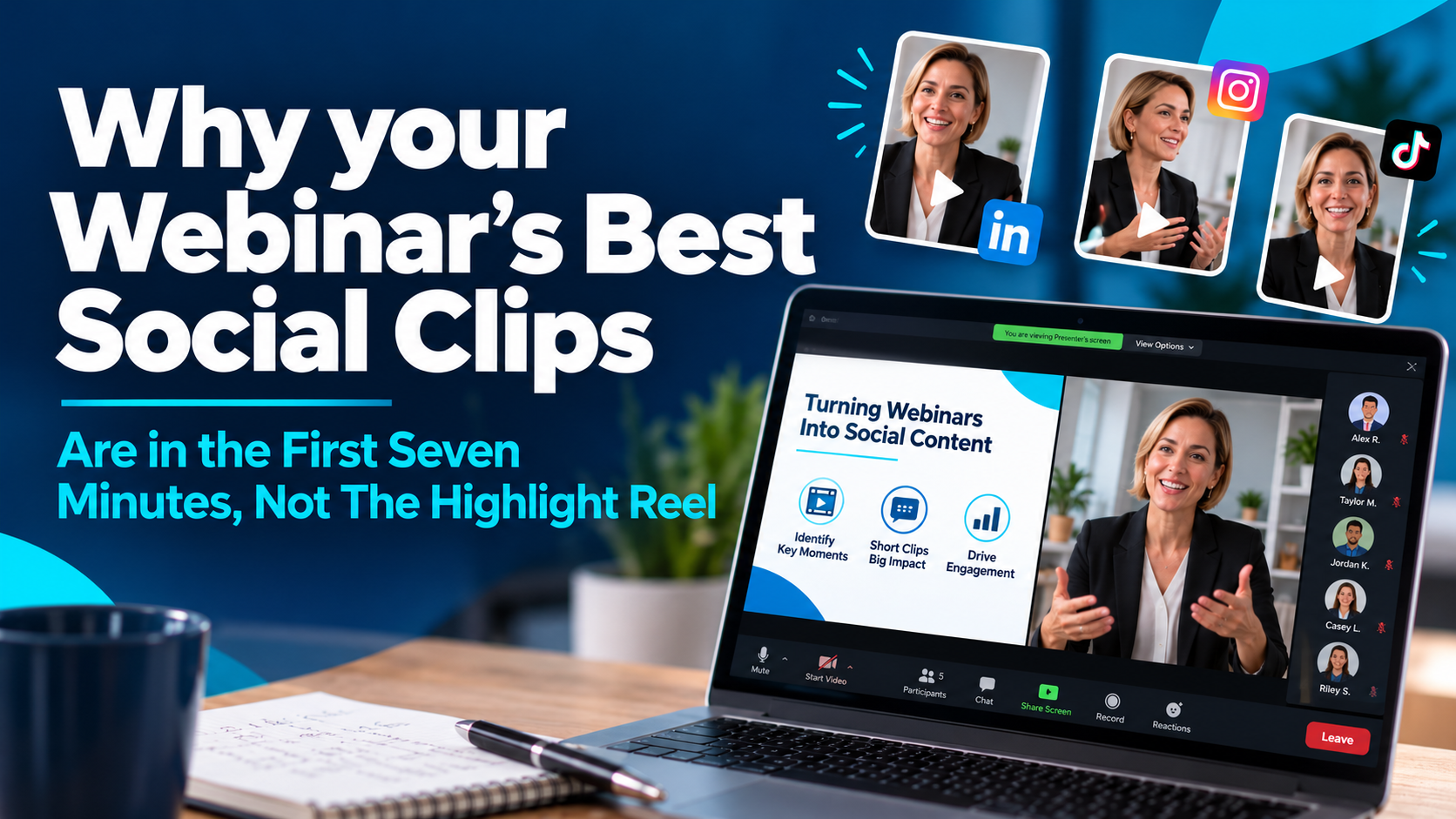
The most shareable moments from your webinar happen before you deliver your main content. Those first seven minutes—the setup, the framing question, the moment you state what’s at stake—contain the tension and context that make a clip work on its own.
The polished highlights you think are gold rarely perform because they arrive without setup and depend on information the viewer doesn’t have.
The Opening Contains the Hook, Not Just the Introduction
Most presenters treat the first few minutes as throat-clearing: housekeeping, introductions, a slow build to the real material. But that framing is exactly what social platforms reward.
When you state the problem your webinar will solve, you’re giving viewers a reason to care before they know the answer. That tension is what stops the scroll.
A clip from minute forty, even if it contains your best insight, assumes the viewer already understands why the insight matters. It drops them into the middle of an explanation with no context. The result is a clip that feels like homework, not a hook.
The opening also tends to be more conversational. You’re still warming up, speaking to the audience as people who showed up with a question, not as students receiving a lesson. That tone translates better to social feeds than the polished delivery that comes later.
Early Moments Are Self-Contained
The first seven minutes tend to contain complete thoughts. You’re stating a problem, naming a misconception, or asking a question that your audience recognizes. These moments don’t require follow-up to make sense—they work as standalone observations.
A clip where you say, “Most people think the hardest part of content creation is coming up with ideas, but it’s actually knowing which ideas your audience will care about before you invest the time to produce them” is a complete thought. It names a misconception and offers a reframe.
Compare that to a clip from later in the webinar where you’re explaining step three of a five-step process. Even if the explanation is clear, the viewer is missing steps one, two, four, and five. The clip feels incomplete because it is.
The setup is designed to stand alone. The payoff is designed to land after a build. That’s why the setup often outperforms the payoff on social platforms.
What This Means for How You Produce Webinars
If the best clips come from the first seven minutes, you should spend more time crafting that opening. Not as a formality, but as the most usable part of your content.
Before your next webinar, write out the problem or question you’re addressing in one or two sentences. Make sure it’s specific enough that someone hearing it for the first time understands what’s at stake. Then deliver that framing with the camera in mind, knowing that this moment might be the only one a social viewer sees.
The highlights reel still has value for people who attended the webinar and want to revisit key points. But if your goal is to reach new people, the opening is where that happens.
About the Author
Dave Evers is Director of Digital Content & Strategy at HelloNation in Rochester, NY.