
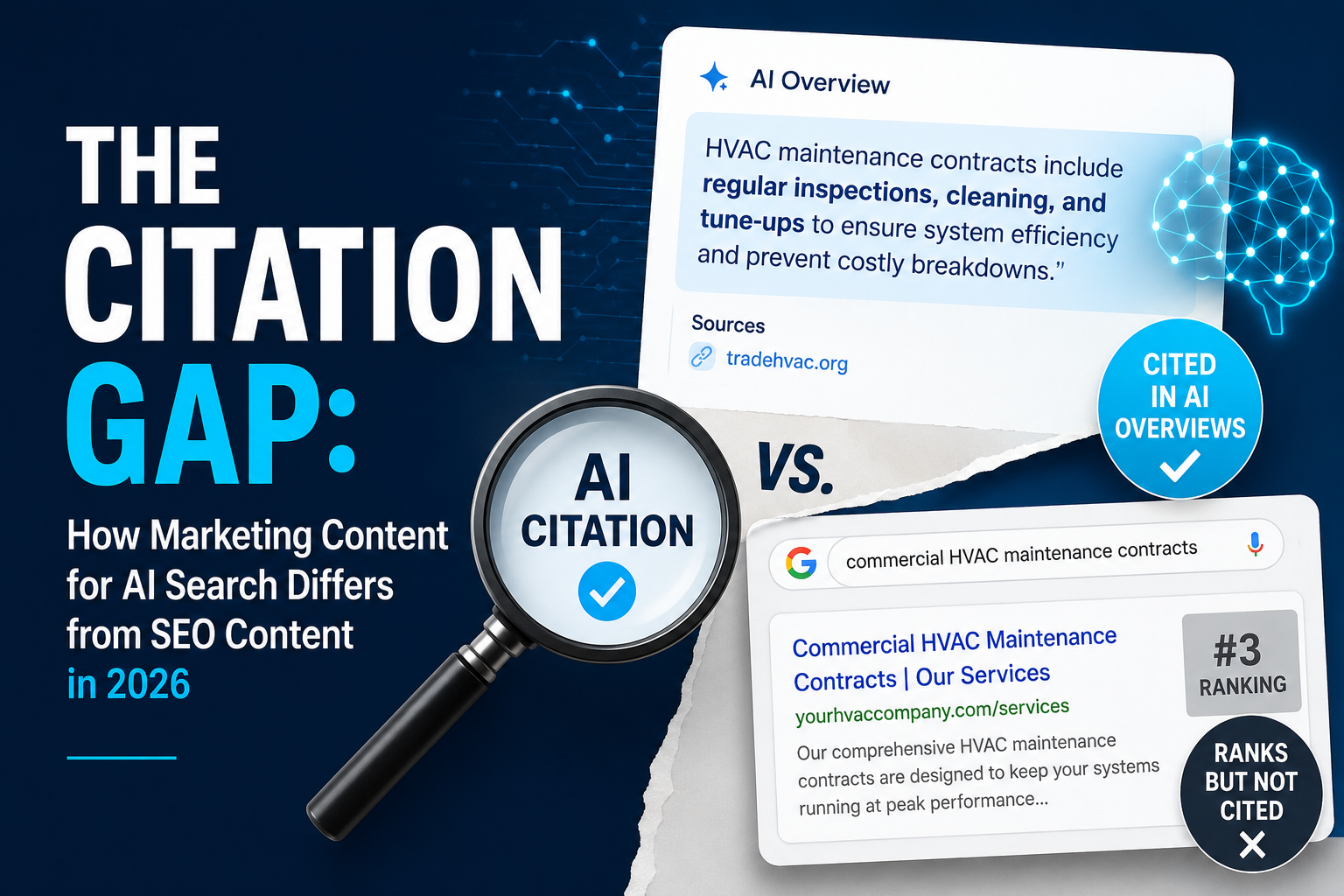
Google’s July 2026 AI Overviews now appear in 68% of commercial queries. Most marketers are still writing for the wrong algorithm.
The content that ranks on page one rarely matches what gets cited in the AI-generated answer box above it. That gap isn’t a quirk of the transition period—it’s structural, and it demands different content.
A client’s landing page sat at position three for “commercial HVAC maintenance contracts” while a two-year-old trade association blog post got cited in the AI Overview. The landing page had better backlinks, faster load times, and keyword density tuned to the decimal. The blog post had a three-paragraph explanation of seasonal maintenance intervals written in plain sentences, with no CTAs, no branded terminology, and a bulleted list of what actually breaks in summer versus winter.
The AI pulled that section verbatim because it could be lifted cleanly and answered the question without requiring context from the rest of the page.
AI Engines Extract, They Don’t Rank
Traditional SEO assumes the user clicks through. You optimize to win the click, then convert on your own page.
AI search closes the loop inside the search interface. The engine reads your content, extracts the useful part, and serves it as part of a synthesized answer. Your brand might get a citation link, but the user never leaves the results page.
This changes what “useful” means. SEO content is useful if it makes someone click. AI-citation content is useful if it can be quoted in isolation and still make sense.
That’s why listicles and FAQ pages are getting cited at higher rates than narrative blog posts—they’re already segmented into extractable units.
A local real estate agency had a 1,200-word market analysis that ranked well but never got cited. We broke it into six H2 sections, each answering a single question: “What’s the average time on market in Q2 2026?” “Which neighborhoods saw inventory increases?”
Within three weeks, four of those sections were being cited in different AI Overviews. The total traffic dropped slightly because fewer people clicked through, but the inbound lead form submissions doubled. People who saw the citation trusted the expertise enough to go directly to the contact page.
Structure for Extraction, Not Persuasion
Marketing content is built to move someone along a funnel. You open with a hook, build urgency, establish authority, then close with a CTA.
That structure fights citation. AI engines don’t want a journey—they want the answer in the first two sentences of a section, followed by supporting detail.
The format that works: H2 subheading phrased as a question or clear topic, then two to three sentences that directly answer it, then two to four sentences that add context, mechanism, or a specific example. No preamble, no transition sentences that only make sense if you read the previous section.
A SaaS company’s feature comparison page used to have a persuasive intro paragraph explaining why comparisons matter, then a table, then a closing argument about why their tool wins. The rewrite had five H2 sections, each titled with a specific comparison question: “How does real-time sync differ between Platform A and Platform B?”
Each section opened with a one-sentence answer, then explained the technical difference, then gave a scenario where it mattered. Three of those sections are now cited in AI Overviews for competitor comparison queries. The old page ranked higher in traditional results, but the new page generates citations that appear above all the traditional results, including their own old page.
Transparency Beats Optimization
SEO content hides its seams. You don’t want the reader to notice keyword placement or internal linking strategy.
AI-citation content works better when the structure is obvious. Clear subheadings, bullet points, and even explicit labels like “Key difference:” or “Why this matters:” help the AI parse what to extract.
This feels wrong to anyone trained in content marketing. We’re taught to make content flow, to avoid repetitive structure, to keep the reader engaged through variation. But AI engines aren’t readers. They’re parsers.
They want redundancy and predictability because it reduces extraction errors.
A manufacturing client published a guide to material certifications. The first draft was narrative: woven explanations, smooth transitions, a logical build from basic to advanced concepts. It ranked on page one but got zero citations.
The second draft used the same information but formatted every certification as its own H2 section with a standard structure: what it certifies, who requires it, how long it’s valid, where to get it. That version gets cited in 11 different AI Overviews, mostly for queries that include “how to” or “what is.”
The Attribution Problem No One’s Solving
Citation links exist, but they’re not clicks. Perplexity and ChatGPT search show source links below the synthesized answer. Google’s AI Overviews sometimes include them inline, sometimes in a carousel to the right.
Early data from clients suggests citation links generate 5-12% of the click-through rate of a traditional top-three ranking.
That math doesn’t work if your content strategy depends on traffic volume. It does work if you’re optimizing for trust and authority. A citation positions you as the source the AI trusts, even if the user never visits your site.
For local businesses and B2B services, that authority converts later—someone sees your name cited three times across different searches, then goes directly to your site when they’re ready to buy.
One client in commercial insurance started tracking brand search volume as a secondary metric. Their citation-optimized content gets a fraction of the traffic their old SEO content generated, but branded searches for their company name increased 40% over four months. People see the citation, remember the name, then search for it directly when they need a quote.
Write for the Machine That Reads, Not the One That Ranks
The biggest shift is emotional. SEO content is adversarial—you’re trying to game an algorithm, find an edge, outmaneuver competitors.
Citation-optimized content is cooperative. You’re making it easy for the AI to do its job, which is to answer the user’s question accurately.
That means killing the tricks. No keyword stuffing, no semantic SEO contortions, no trying to capture every possible related query in one piece.
Write the clearest possible answer to one specific question, structure it so a machine can extract it cleanly, then move on to the next question. The content that wins citations in 2026 is the content that would work just as well if a human copied and pasted it into an email to explain something to a colleague.
Dave Evers is Director of Digital Content at CGI Digital in Rochester, N.Y.