
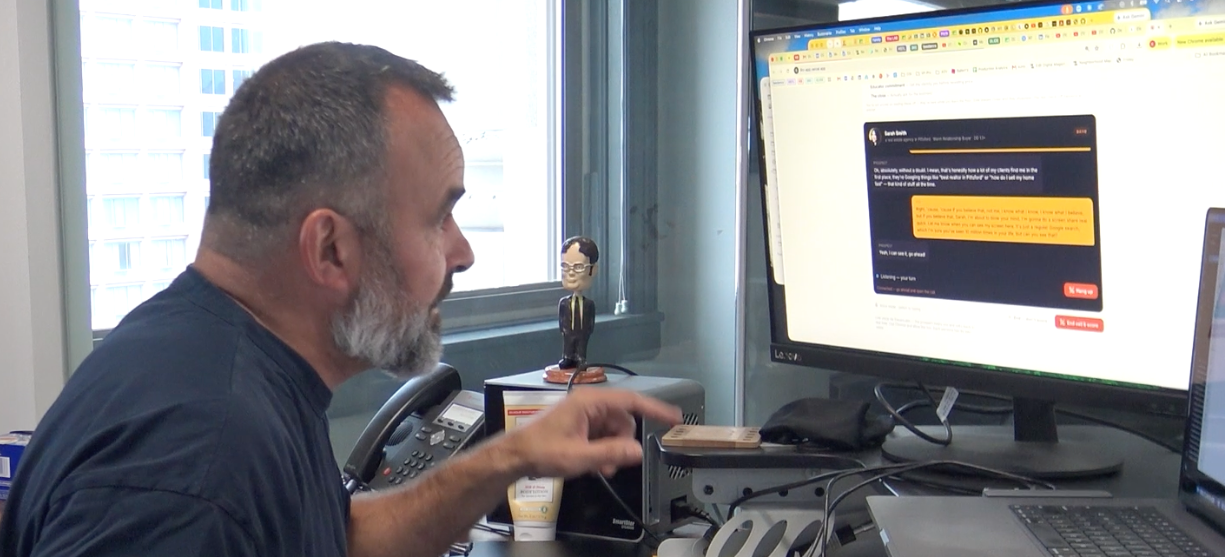
After six weeks of running an AI practice simulator with our own sales team, here’s the short answer: yes — but only if two conditions are met. The AI prospect has to behave like your real prospects, not a movie version of one. And the scoring has to judge the quality of the call, not whether it ended in a close. Miss either condition and you’ve built a video game. Hit both and you’ve built the thing sales training has been missing for decades: a place to practice that isn’t a live prospect.
Why Sales Practice Disappeared in the First Place
Every skilled profession practices somewhere safe. Pilots have simulators. Athletes have practice ice. Surgeons have cadaver labs. Sales reps have — what, exactly? Role-playing with a manager, where the manager is a bad actor and the rep can’t afford to fail in front of the person who writes their review. So most reps do their actual learning on live calls, which means the most expensive place to make a mistake is the only place they’re allowed to make one.
That’s the gap AI role-play fills. A rep can pitch out loud, fail, get scored, and run it again ten minutes later — with nobody watching and nothing at stake. The question was never whether that would be useful. The question is whether the simulation is real enough to build habits that transfer.
An AI Prospect Is Only Useful If It Behaves Like a Real One
Here’s the mistake we made first, and the one most AI training tools make permanently: we built a prospect that argued too much.
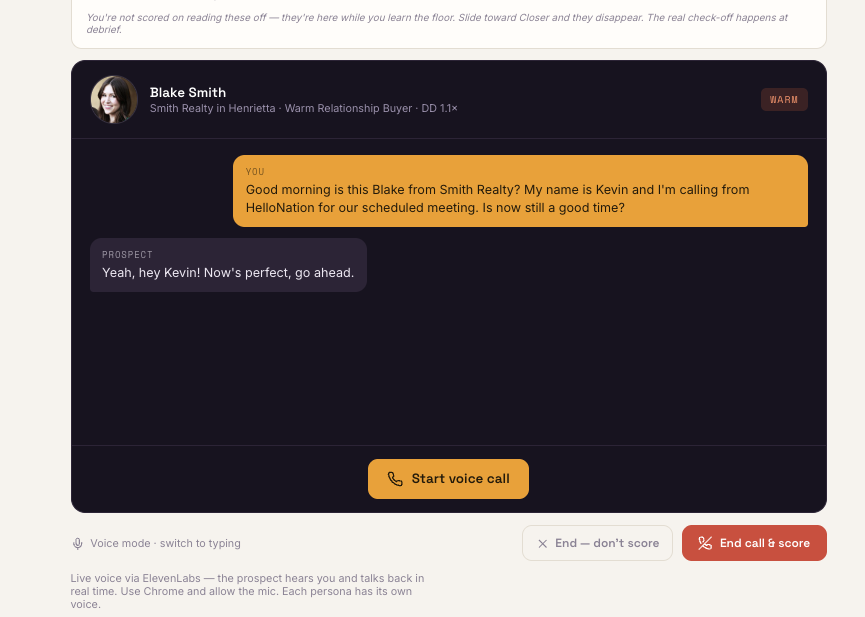
It felt rigorous. It was wrong. When we calibrated the simulator against recordings of our own best reps’ real calls, the pattern was unmistakable: real prospects mostly ask questions. Buying questions. Clarifying questions. They engage; they rarely fight. A simulator that throws constant objections trains reps to brace for combat that never comes — and never teaches them to handle the thing that actually happens, which is a cooperative conversation that still doesn’t close.
So the fix wasn’t making the AI prospect harder. It was making it truer. The difficulty dial shouldn’t control how much the prospect argues; it should control how the prospect engages — a warm long-time client asks different questions than an analytical owner who wants every number justified. Both are realistic. Neither is a fight.
The calibration source matters just as much. We built our personas from our own recorded calls, not from a sales methodology book. If you train reps against a generic prospect, you get reps who are prepared for a generic market. Your real prospects have a texture, and your best reps’ real calls are where that texture lives.
Grade the Call, Not the Close
The second condition is harder to accept: the scoring has to be outcome-blind.
When we analyzed our best reps’ real calls, some of the strongest calls didn’t close in the room — the decision-maker had a partner to consult, wanted terms in writing, needed a day to think. Those aren’t failures. They’re legitimate stages of a real buying process, and a rep who handles them well is doing excellent work. Meanwhile, the easiest close in our sample was also the easiest room — a warm, long-standing relationship where the sale was mostly made before the call started.
If your grader rewards closing, it rewards drawing the easy room. Reps learn to chase conditions instead of building skill. So our simulator scores the call itself — discovery, responsiveness, structure, and whether the close attempted was appropriate to the room — and adjusts for difficulty, the way a judge scores a dive by more than the splash. A well-run hard room outscores a coasted easy one.

What Six Weeks of Real Use Looks Like
Since June 30, five of our reps have run thirty practice calls. Our most consistent user’s scores climbed from the high 70s to an 89 average across her last three calls — not because the grader softened, but because her discovery got sharper each round. The one-line review from one of our veteran reps isn’t printable, but it was emphatic.
And the honest finding: the technology was the easy part. Getting busy humans to practice is as hard as it has always been. Five reps have access; the ones who keep showing up are pulling ahead. AI removed every excuse except the human one — which turns out to be the load-bearing excuse. Any team considering this should budget more effort for building the practice habit than for building the tool.
You Don’t Need a Developer to Build One
Worth saying plainly: I’m not a developer. I’m a VP of Production who has spent 26 years in video. I built this simulator the same way I’ve built every tool I’ve made this year — by describing what I wanted, in plain English, to an AI. The personas, the scoring philosophy, the way a call should open and flow: all of it started as sentences, not code.
The build loop looked exactly like a production review. Use it, notice what’s off, describe the problem, get a new version, test again. The notes were never technical — they were things like “a real prospect wouldn’t argue here, she’d ask a question.” And that’s precisely why the calibration worked: the person giving the notes knew our calls. A vendor’s engineers never would have. The expertise your simulator needs isn’t software expertise — it’s knowing what a good call in your business actually sounds like, and being able to say it clearly.
If You’re Considering AI Role-Play for Your Team
Start with your own calls, not a vendor’s defaults — record your best reps and calibrate against how your actual prospects behave. Insist on outcome-blind scoring, or you’ll train condition-chasers. Treat difficulty as a change in who the prospect is, not how hostile they are. And keep the scores as coaching inputs, not a leaderboard — the value is in what a rep does differently on the next run, not in the number.
Does AI role-play training work for sales teams? Ours says yes: measurably better calls within weeks, from the reps who practice. The simulator was buildable in a summer. The realism and the scoring philosophy are what make it training instead of a toy — and the practice culture is what makes it matter at all.
About the Author
Kevin Baer is VP of Production at CGI Digital in Rochester, NY, with 26 years in video production and motion graphics.