
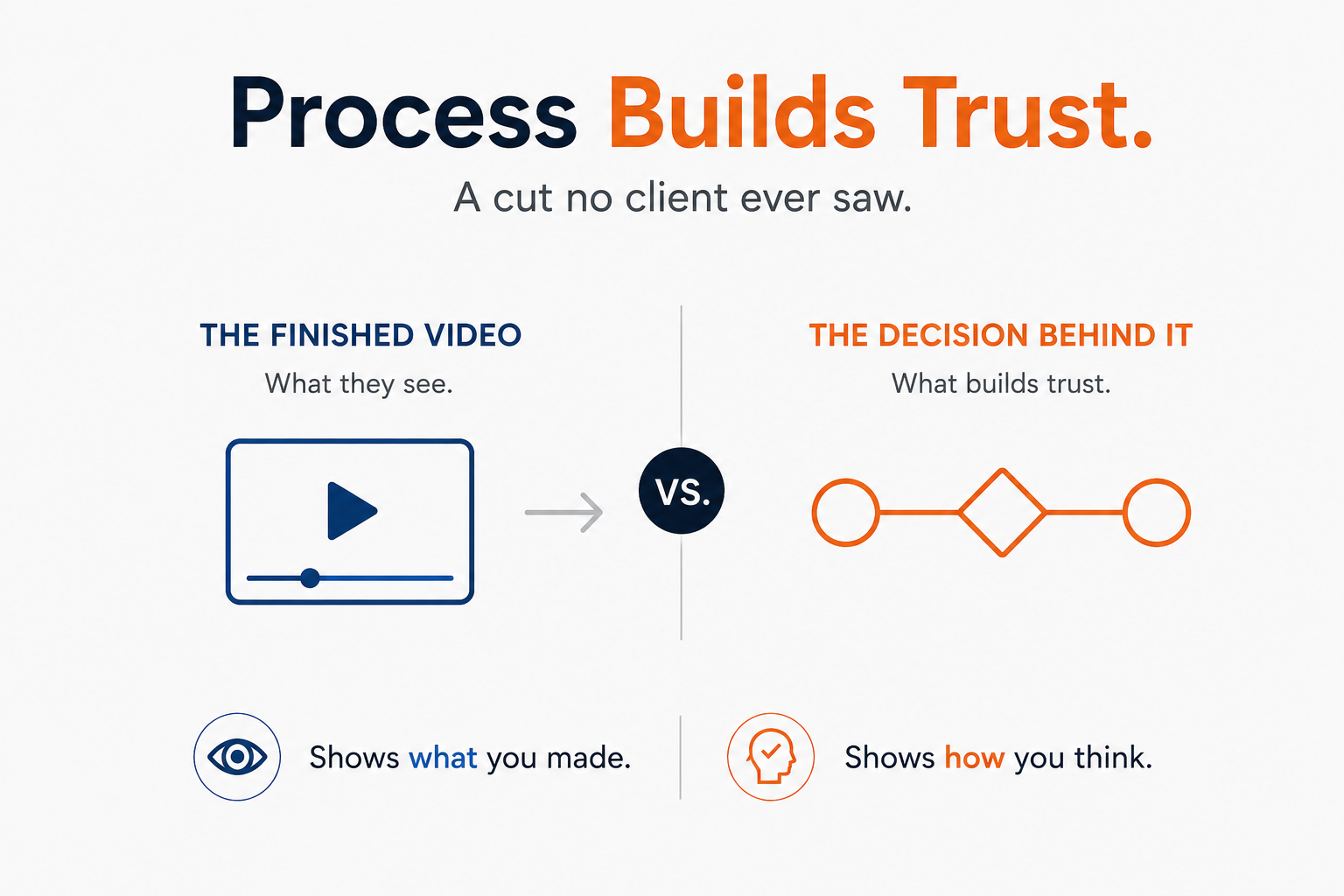
Every video team eventually asks some version of this question: does behind-the-scenes content — the process, the decisions, the unpolished work — actually build trust, or is it just filler between the finished pieces? After 26 years in production, my answer is that it builds more trust than the finished video does. But not for the reason most people give. Let me tell you about a cut nobody ever saw.
The two versions
Fifteen years ago I edited a piece for a fertility clinic. The subjects were women and couples who’d been told a family probably wasn’t in the cards, now raising kids because of this doctor. It was about as emotional as material gets.
I cut two versions. One followed the storyboard to the letter — the version the client had signed off on, safe and on-spec. The other I built to do exactly one thing: make it impossible to watch and not feel the full weight of what these families had been through.
The client went with the storyboard version. That was their call to make, and I don’t hold it against them.
But that second cut is still, fifteen years and a hundred better tools later, probably top five in my entire career for carrying emotion. The footage was rougher. The effects are dated now. I wasn’t half the editor I am today. None of that mattered. The piece worked because of a single decision — to chase the feeling instead of the checklist — and that decision doesn’t appear anywhere in the delivered file.
The part we never show
That decision is invisible. We hand clients the approved cut and quietly bury the version where the actual craft happened — the alternative, the choice, the reason one won. The finished video is the evidence. The decision behind it is the craft. And we almost never let anyone see the craft.
That’s the real case for behind-the-scenes content, and it has little to do with “authenticity” or “humanizing the brand.” Those are byproducts. The actual mechanism is simpler:
- A finished video shows someone what you made. The decision behind it shows how you think — and how you think is the only thing that predicts what you’ll do with their story.
- Polish no longer signals much. The tools made everyone’s work competent, so a clean final frame proves you own the software, nothing more. Judgment is what still separates people, and judgment only becomes visible when you narrate a call you made.
- The most persuasive asset you own isn’t your best finished piece. It’s a moment where you chose between two good options and can still explain the choice.
So when someone shows their process, the trust doesn’t come from the rawness being charming. It comes from watching a professional make a judgment call and being able to agree with it before any money changes hands.
What this means if you make video for a living
Show the decision you’re a little proud of and a little unsure about. Show the scene you cut and what it cost you. Show the version the client didn’t pick and why you’d still defend it. That’s the content that tells a prospective client what they’re actually buying when they hire you — long before they’ve seen a single finished frame.
The polished cut closes the current project. The decision behind it is what earns the next one.
Kevin Baer is VP of Production at CGI Digital in Rochester, NY, with 26 years in video production and motion graphics.