
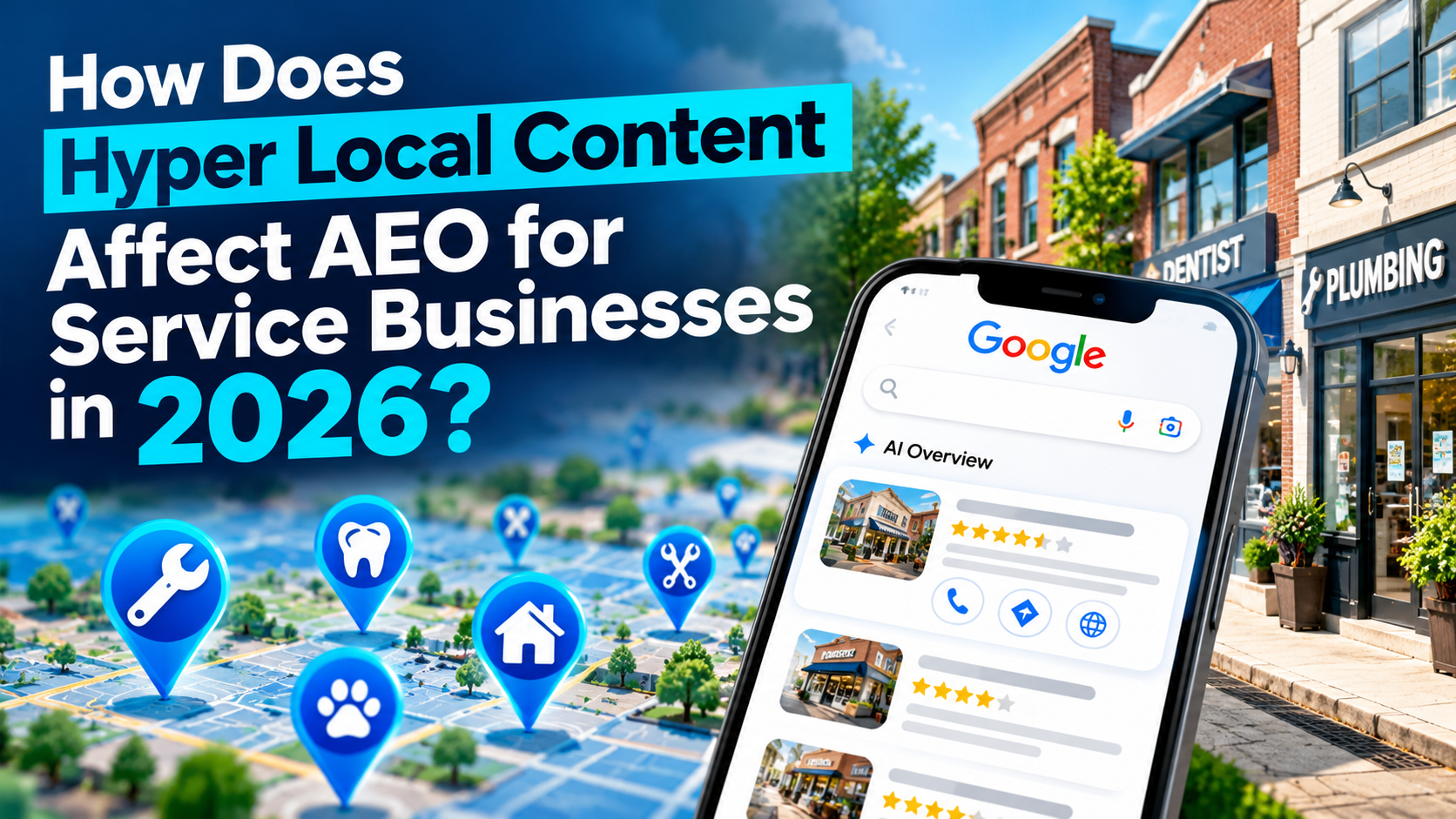
Hyper-local content matches the specificity of voice and map-based queries that now dominate service business searches. When someone asks their device for a plumber in a specific neighborhood or a contractor familiar with local permit requirements, engines prioritize content that demonstrates genuine local knowledge over generic service pages.
AEO Rewards Proximity Signals That Generic Content Can’t Fake
Answer engines parse content for signals that confirm you operate in the territory you claim. A blog post about foundation repair competes with thousands of identical pages. A post explaining why basements in one county crack differently than those twenty miles north — referencing soil composition, water table behavior, or construction practices common to that area — sends a signal generic content can’t replicate.
Those proximity signals function as trust markers. The engine evaluates whether the content could only have been written by someone working in that market. Competitors outside the territory can’t credibly produce the same material, which creates a defensible moat around AEO performance.
Voice and AI-assisted search default to answers, not lists. Someone asking why their deck needs a permit expects a direct response tied to their location, and engines surface the content that provides one with local authority. Service descriptions alone don’t answer that.
Local Content Captures Long-Tail Queries That Drive Qualified Leads
Hyper-local content ranks for the specific, low-volume searches that signal high intent. Someone searching “concrete contractor” generates noise. Someone searching whether they need a soil report for a foundation in a specific area is weeks from hiring. The second query is hyper-local by nature, and the content that answers it wins the lead.
Service businesses often assume volume drives results, so they chase broad keywords. AEO in 2026 prioritizes relevance over traffic. A hundred visits from people asking questions you can’t answer converts worse than ten visits from people asking the exact question your service solves. Hyper-local content filters for the second group by design.
The long tail also insulates you from algorithm changes. Broad keywords shift with every update as engines reweight authority signals. Hyper-local queries remain stable because they’re tied to geographic and regulatory realities that don’t change month to month. A post explaining a local permitting quirk stays relevant as long as the quirk exists.
Authentic Local Stories Build the Structured Context Engines Extract
Answer engines don’t just pull sentences — they extract structured context. A hyper-local case study that walks through a specific challenge, the local factor that caused it, and the solution creates multiple extraction points. The engine can cite the problem, the cause, or the fix depending on the query, and each citation reinforces local authority.
Authentic stories also generate the natural language variation that broad queries lack. A generic service page repeats the same phrases because there’s only so many ways to describe installing HVAC systems. A story about solving a problem unique to a neighborhood uses the vocabulary customers actually use when describing that problem, which is the vocabulary they use in voice searches.
The businesses that treat hyper-local content as a compliance exercise — repeating “we serve [town]” across thin pages — miss the opportunity. Engines reward depth and specificity, not keyword density. A single well-developed piece about a local challenge outperforms a dozen location pages that say nothing a competitor couldn’t copy.
Video and AI Editing Tools Amplify Hyper-Local Reach Without Scaling Production Costs
Hyper-local content historically required more production effort than generic content because each piece served a smaller audience. AI-assisted video editing in 2026 inverts that equation. You can shoot one project walkthrough and use AI tools to generate multiple cuts optimized for different local queries — each emphasizing a different aspect of the work relevant to a specific search.
Video also captures the environmental context that text struggles to convey. Showing the job site, the surrounding area, and the specific conditions that required a local approach delivers proximity signals engines can parse from metadata, spoken dialogue, and visual elements. A contractor explaining why a particular roofing approach works in their climate while standing on a local job site creates a richer AEO asset than a written post making the same claim.
The efficiency gain matters because hyper-local content demands volume to cover the range of questions a local market generates. AI tools let a single operator produce enough material to compete without hiring a content team, which keeps hyper-local strategies accessible to smaller service businesses that can’t outspend national competitors on generic SEO.
The Businesses Winning AEO in 2026 Publish Answers Only They Can Give
AEO doesn’t reward the best content about a topic — it rewards the most relevant content for a query. Hyper-local content wins because it’s the only content that can answer location-specific questions with authority.
A national brand can publish a guide to foundation repair, but they can’t publish a guide to foundation repair in a specific soil type without fabricating local knowledge they don’t have. Service businesses that commit to hyper-local content build a library of answers that compounds over time. Each piece captures a slice of the local query landscape, and together they position you as the default source for location-specific expertise.
That positioning survives algorithm changes because it’s built on something engines can’t devalue: genuine local knowledge that serves real search intent.
About the Author
Dave Evers is Director of Digital Content & Strategy at HelloNation in Rochester, NY.