
Yes, but only if it helps you tell a story someone in your town actually needs to hear.
Most small business owners considering AI video tools in 2026 are asking the wrong question. They’re wondering whether the technology works or whether it’s affordable. Both answers are yes.
The real question is whether the output serves anyone beyond your own marketing checklist.
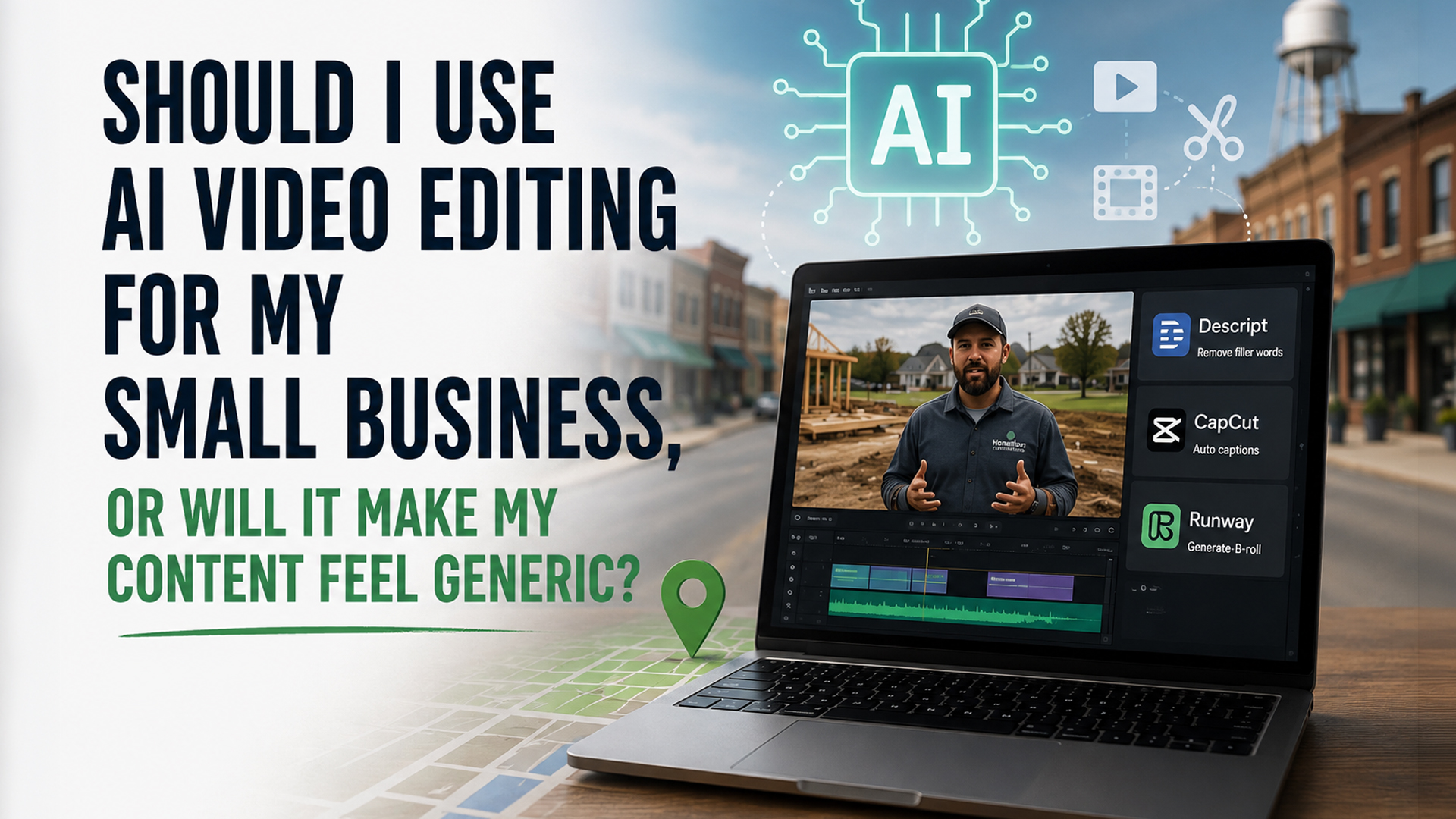
AI video editing has become remarkably capable. Tools like [Descript](https://www.
Relevance is the only thing that matters when your audience is a few hundred people within a ten-mile radius.
The Local Relevance Test: Three Questions Before You Automate
Before you hand any part of your video workflow to an AI tool, ask whether the output will reflect something specific to your community.
A dental practice in Boise has different concerns than one in Tampa. A landscaping company in Vermont faces different seasonal challenges than one in Phoenix. AI tools trained on massive datasets default to the generic.
They’ll give you clean edits and smooth transitions, but they won’t know that your town just voted down a zoning change or that the local high school’s football team made state finals.
The test is simple: if you removed your business name and logo from the video, could it belong to any business in any city? If yes, the content fails.
Your potential clients don’t need another explainer video about “the importance of regular maintenance.” They need to see that you understand the specific problem they’re dealing with—the clay soil that wrecks foundations in their neighborhood, the permitting process that just changed last month, the supplier shortage affecting local projects.
AI editing tools excel at technical cleanup. They’re terrible at recognizing what makes a story matter to a specific group of people.
Where AI Editing Actually Helps: Removing Friction, Not Thinking
The best use case for AI video editing in small business content is eliminating the tedious parts that prevent good stories from getting published at all.
A contractor records a walkthrough of a finished basement renovation. The footage is solid, but it’s full of pauses, repeated explanations, and moments where the client’s dog wanders through the frame. Cleaning that up manually takes two hours. Running it through Descript’s filler word removal and scene detection takes eight minutes.
That’s the win.
The AI didn’t create the story or decide what mattered. It removed the friction between raw footage and a publishable piece. The contractor still had to know which project to feature, what details to emphasize, and how to frame the client’s problem in a way that resonates with other homeowners facing the same issue.
Here’s another example: a local bakery films a short video every week showcasing a seasonal item. The owner doesn’t have time to learn Premiere Pro, but she can record a 90-second clip on her phone and let CapCut’s auto-caption and template system handle the formatting.
The AI handles the mechanical assembly. She handles the decision to feature the apple cider donut in October because that’s what her customers ask for when the weather turns.
The pattern holds across industries. AI editing works when it removes obstacles to publishing content you already know needs to exist. It fails when you expect it to decide what’s worth saying.
The Template Trap: Why Auto-Generated Styles Hurt Local Businesses
Most AI video tools in 2026 offer template libraries—pre-built styles, transitions, and text animations designed to make your content look “professional.” For small businesses trying to build trust in a local market, these templates are poison.
They make every video look like every other video. They signal to your audience that you’re not paying attention to them specifically.
A real estate agent in a college town needs a completely different visual approach than one in a retirement community. The college town agent should be showing walkable neighborhoods, proximity to campus, and affordable starter homes. The retirement community agent should be highlighting single-level floor plans, accessibility features, and proximity to medical facilities.
But if both agents use the same AI-generated template with the same upbeat music and the same kinetic text animations, they’ve erased the very specificity that would make their content useful.
Templates are designed for scale. Local businesses don’t scale—they deepen. The goal isn’t to reach more people; it’s to reach the right people more effectively.
That requires making deliberate choices about tone, pacing, and visual style that reflect the community you’re serving. AI tools can execute those choices once you’ve made them, but they can’t make the choices for you.
When to Ignore AI Entirely: Stories That Require Presence
Some content shouldn’t involve AI editing at all.
Customer testimonials, behind-the-scenes footage, and community event coverage all benefit from a rough, unpolished feel that signals authenticity. A small business owner interviewing a long-time customer doesn’t need perfect cuts or automated B-roll. The value is in the unscripted moment, the genuine reaction, the specific detail that only that customer would mention.
A landscaping company recorded a client talking about why she hired them. Mid-interview, she mentioned that the crew noticed her irrigation system was leaking and fixed it without being asked.
That detail—spontaneous, specific, and unrehearsed—is worth more than any polished marketing message. Running that footage through an AI editor that smooths out pauses and tightens pacing risks cutting the very moments that make the story credible.
The same applies to event coverage. A small business sponsoring a local charity run doesn’t need cinematic drone shots and color-graded footage. They need recognizable faces, genuine reactions, and proof that they showed up.
Raw footage shot on a phone, lightly trimmed but otherwise untouched, communicates presence in a way that heavily edited content cannot.
What You’re Actually Optimizing For
Use AI video editing when it helps you publish more of the content you already know matters. Avoid it when it tempts you to prioritize production value over relevance.
The technology is a tool for removing friction, not a replacement for judgment about what your specific audience needs to hear.
If you’re editing a video and find yourself choosing an AI-generated option because it looks more professional, stop and ask whether “professional” is actually what your audience values. In most local markets, they value recognition—the sense that you understand their specific situation and have something useful to say about it.
That’s the test AI can’t pass on its own.
About the Author
Dave Evers is Director of Digital Content at CGI Digital in Rochester, NY.