
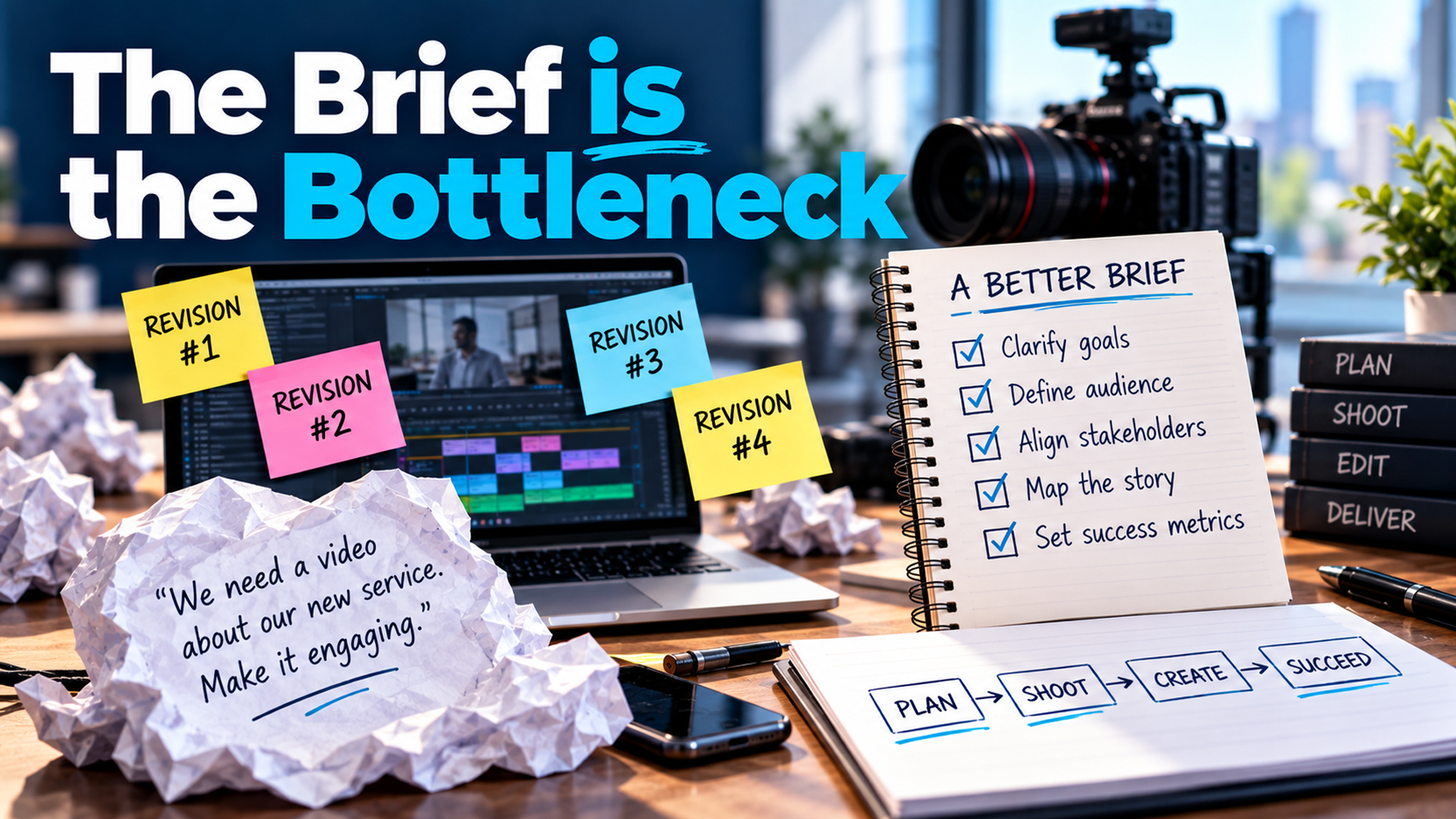
Most content projects fail before the camera turns on. A client emails a two-sentence brief: “We need a video about our new service. Make it engaging.” You schedule the shoot, and three revisions later you’re rebuilding the entire narrative because nobody clarified who the audience was or what problem the service actually solves.
The brief wasn’t incomplete. It was a placeholder, and placeholders cost weeks.
The math is consistent. Three hours spent interrogating the brief, mapping stakeholder expectations, and defining success metrics eliminates roughly fifteen hours of rework. When you skip planning, you’re not saving time — you’re deferring decisions to the revision stage, where every change requires re-editing footage, re-recording voiceover, and re-negotiating timelines with people who assumed you were nearly done.
The Brief Pretends to Answer Questions It Never Asked
A typical brief includes a deadline, a rough topic, maybe a target length. What it doesn’t include: the specific behavior change the content should trigger, the misconceptions the audience currently holds, or the three sentences the client would be thrilled to hear a viewer repeat after watching.
Without those answers, you’re guessing. You interview someone assuming their technical expertise is the hook, but the client wanted emotional reassurance for nervous first-time buyers. You structure the video as a how-to, but the real goal was brand differentiation.
Every guess that lands wrong becomes a revision note. Revision notes compound because fixing one section often breaks the flow of two others.
The bottleneck isn’t the client’s inability to articulate needs. It’s the assumption that a brief is a starting point rather than a negotiation. Treat the initial brief as a draft and spend two hours in a working session with the client — you’ll surface the unspoken priorities.
You’ll learn that “engaging” actually means “doesn’t feel like a corporate training video.” You’ll discover that “new service” is a repackaging of an old offering and the real story is why they finally made it accessible to small businesses.
Planning Exposes the Stakeholder Minefield Before You Step In It
Here’s a pattern that repeats: you deliver a first cut that the primary contact loves. Then it goes to the VP, who has a completely different vision. Then it goes to the communications team, who flags three brand guideline violations.
Suddenly you’re in revision four. The project that was supposed to take a week has eaten a month.
Planning doesn’t prevent stakeholder disagreement, but it forces that disagreement to happen early. A three-hour kickoff meeting where everyone with approval authority sits in the same room means the VP’s vision and the communications team’s concerns surface before you’ve shot a frame. You map who has veto power over what, and you get contradictory feedback resolved while it’s still theoretical.
One client project last year involved a promotional video for a community initiative. The initial brief was straightforward: highlight the program’s impact. Three hours of planning revealed that two board members had fundamentally opposed views on whether the video should emphasize individual success stories or systemic community benefits.
Getting that resolved in the planning phase meant shooting with a clear narrative structure. Skipping it would have meant delivering a cut that satisfied no one and starting over.
Revisions Multiply Because Context Lives in Your Head, Not the File
When you revise without a documented plan, you’re working from memory. You remember why you framed a shot a certain way or why you chose that particular soundbite. The client doesn’t.
They see the current cut in isolation, disconnected from the strategic decisions that shaped it.
That disconnect turns every revision into a renegotiation. The client asks you to cut a section that you included specifically to address a concern they raised in an earlier email. You explain, they apologize, and you move on — but that exchange just cost twenty minutes, and it’s happening five times per revision cycle.
A planning document that maps every section to a specific strategic goal eliminates most of that. When a client questions a choice, you point to the section of the plan where they approved it. When they request a change, you can immediately flag what else it affects.
“If we cut that section, we lose the setup for the call-to-action” is a much faster conversation than rebuilding the edit and discovering the problem after the fact.
AI tools in video editing are making the technical execution faster — automated transcription, smart B-roll suggestions, one-click color grading. But speed in execution just magnifies the cost of unclear direction. You can now produce a polished rough cut in half the time, which means you can also produce the wrong polished rough cut in half the time and spend twice as long fixing it.
The Real Cost Is Opportunity, Not Hours
Fifteen hours of revisions isn’t just fifteen hours. It’s fifteen hours during which you can’t take on the next project, can’t pitch the next client, and can’t build the next piece of work that actually moves your reputation forward.
It’s the difference between completing eight projects in a quarter and completing five.
Clients remember projects that shipped on time and met expectations more than they remember projects that eventually turned out well after painful iteration. The brief is where you set those expectations, align on what success looks like, and build the shared context that makes every subsequent decision faster.
Three hours planning a project feels like overhead when you’re eager to start shooting. Fifteen hours revising a project that missed the mark feels like failure.
The bottleneck isn’t the tools, the timeline, or the budget. It’s the unwillingness to treat the brief as the actual work instead of the paperwork before the work.
About the Author
Dave Evers is Director of Digital Content & Strategy at HelloNation in Rochester, NY.