
Businesses are slashing video budgets to chase AEO—Answer Engine Optimization. They’re betting on text that AI engines can parse, quote, and serve as direct answers. Video requires more processing and offers less extractable data, so it’s getting cut. The logic seems sound until you watch what happens when a prospect actually needs to decide.
AEO Rewards What’s Easy to Extract, Not What Persuades
Answer engines want clean, quotable blocks: lists, definitions, step-by-step breakdowns. A three-minute brand story can’t be lifted into a ChatGPT response the way a bulleted FAQ can. Marketing teams are cutting video production to fund more blog posts, more Q&A pages, more text that feeds the machine.
Extractability and persuasiveness aren’t the same thing. A prospect researching enterprise software might land on your AEO-optimized comparison chart through an AI search. That gets them in the door. But when they’re deciding between you and two competitors, they’re not reading bullet points—they’re watching the demo video, the founder interview, the case study walkthrough that shows them what working with you actually looks like.
A SaaS client shifted budget from customer testimonial videos to written case studies because their SEO consultant said text performed better in search. Traffic went up. Conversion rate dropped by 18% over six months. The written cases answered questions, but they didn’t build the confidence needed to close a $50K annual contract.
Video Carries Context That Text Can’t Replicate
Text delivers information. Video delivers information plus tone, hesitation, conviction, and the dozen micro-signals that tell a viewer whether someone actually believes what they’re saying.
When a CEO explains a pivot in a two-minute video, you’re not just hearing the strategy—you’re watching whether they’re reading a script or speaking from experience. That distinction matters more as buying cycles get longer and committees get larger.
A procurement team vetting vendors doesn’t just need to know what you do. They need to assess whether you understand their problem and whether your team can execute. A well-produced narrative video—one that shows process, not just outcome—does that work in ways a text page can’t.
Answer engines can summarize your service offering. They can’t replicate the moment a potential client watches a behind-the-scenes video of your team solving a messy problem and thinks, “These people get it.” Complex decisions require more than data points.
The Real Cost Is in What You’re Not Capturing
Cutting video budgets means you’re not documenting the moments that differentiate you. The client conversation that reveals how you think. The project debrief that shows how you recover from setbacks. The founder’s unscripted take on where the industry is headed.
Those moments don’t fit neatly into AEO frameworks, so they get skipped. But they’re exactly what a prospect remembers six months later when they’re finally ready to sign.
A consultancy had been producing quarterly “state of the practice” videos—15-minute deep dives where partners discussed emerging challenges in their field. When budget cuts hit in early 2025, those videos were the first to go. The firm’s content calendar filled up with listicles and how-to guides optimized for search.
A year later, inbound leads were up, but deal size was down. New prospects knew what the firm did, but they didn’t understand how the firm thought. The videos had been doing quiet work—building authority and trust with senior buyers who weren’t clicking through from search results but were being forwarded links by colleagues. Cutting them didn’t show up in analytics dashboards, but it showed up in revenue.
AEO and Video Aren’t Competing Strategies
The mistake isn’t investing in AEO. It’s treating AEO and video as a zero-sum trade-off.
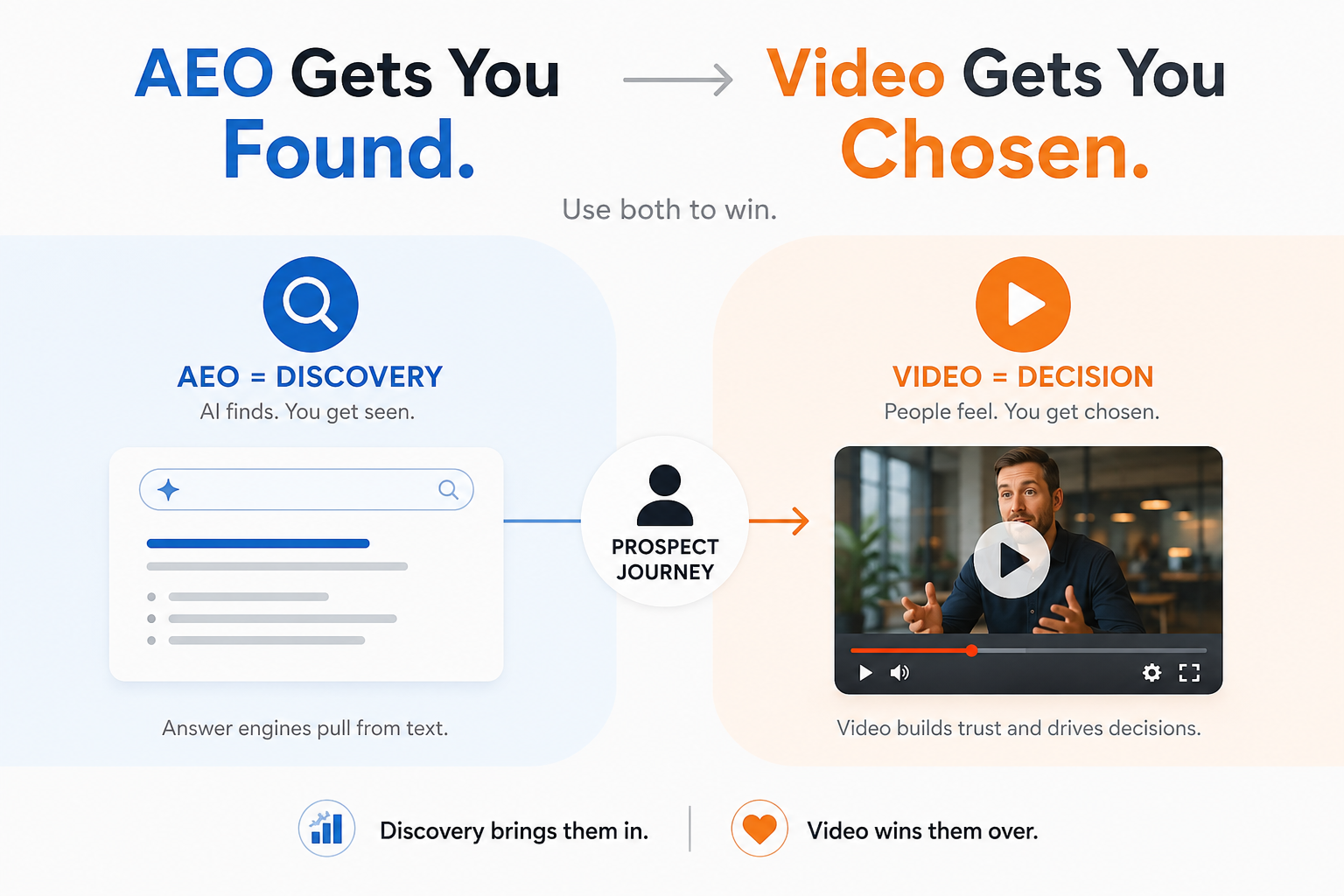
Answer engines are excellent at getting you discovered. Video is excellent at getting you chosen. You need both, and they work in sequence.
A prospect’s first touchpoint might be an AI-generated summary of your service pulled from an optimized FAQ page. But their last touchpoint before they decide—the one where they’re choosing between you and someone else who also ranks well—is almost never text. It’s the video that made them feel like they understood who you are.
Smart businesses in 2026 are structuring their content strategies around that sequence. They’re using AEO to own the top of the funnel and video to close the bottom. They’re not cutting video budgets—they’re reallocating them toward fewer, higher-stakes pieces that do work text can’t.
A single well-produced narrative that captures your actual methodology is worth more than ten generic explainer videos. It’s certainly worth more than another round of blog posts that say the same thing your competitors are saying. AEO is a discovery tool, not a decision tool. If you’re cutting video to chase AI citations, you’re optimizing for being found while making it harder to be chosen.
Tim Epner is Director of Videography at CGI Digital in Rochester, NY.